Inspired by A2UI · Powered by Makepad 2.0

From Agent
to App

AI Agents don't just chat anymore — they build entire apps. Dynamic, interactive interfaces generated on-the-fly, rendered natively across every device.

agent.ts
// Your agent describes UI — the client renders it natively
const response = await agent.generate({
  prompt: "Build a dashboard for sales analytics",
  output: "a2ui", // declarative UI, not code
});

// Streams rich components — charts, tables, forms
// Renders on web, mobile, desktop — same response
await surface.render(response.components);

Agent thinks. App appears.

Three steps from natural language intent to a fully interactive application, rendered natively on any platform.

01
💬

Describe What You Need

Tell the agent what you want in plain language. A booking form, a data dashboard, an inventory tracker — anything.

02
🧠

Agent Generates UI

The AI agent produces declarative UI components — structured data, not executable code. Safe, streamable, and framework-agnostic.

03

Native Rendering

Your client renders the UI using its own native widgets — Angular, React, Flutter, or mobile. Same response, every platform.

Not just chat.
Full applications.

Taking inspiration from the A2UI protocol and running on Makepad 2.0, A2App turns AI agents into app generators — secure, declarative, and universal.

Security

Declarative, Not Executable

Agents send structured component descriptions — never raw code. No injection attacks, no sandbox escapes. Your catalog controls what's allowed.

Streaming

Progressive Rendering

UIs build in real-time as the agent generates them. Users see the interface materializing — no waiting for complete responses.

Universal

One Response, Every Platform

A single agent output renders natively on web, iOS, Android, and desktop. Your design system, your components, every device.

Interactive

Two-Way Communication

Users interact with generated UIs — fill forms, click buttons, manipulate data — and actions flow back to the agent for dynamic responses.

From prompt to app,
in seconds.

Watch an AI agent transform a simple request into a fully interactive application.
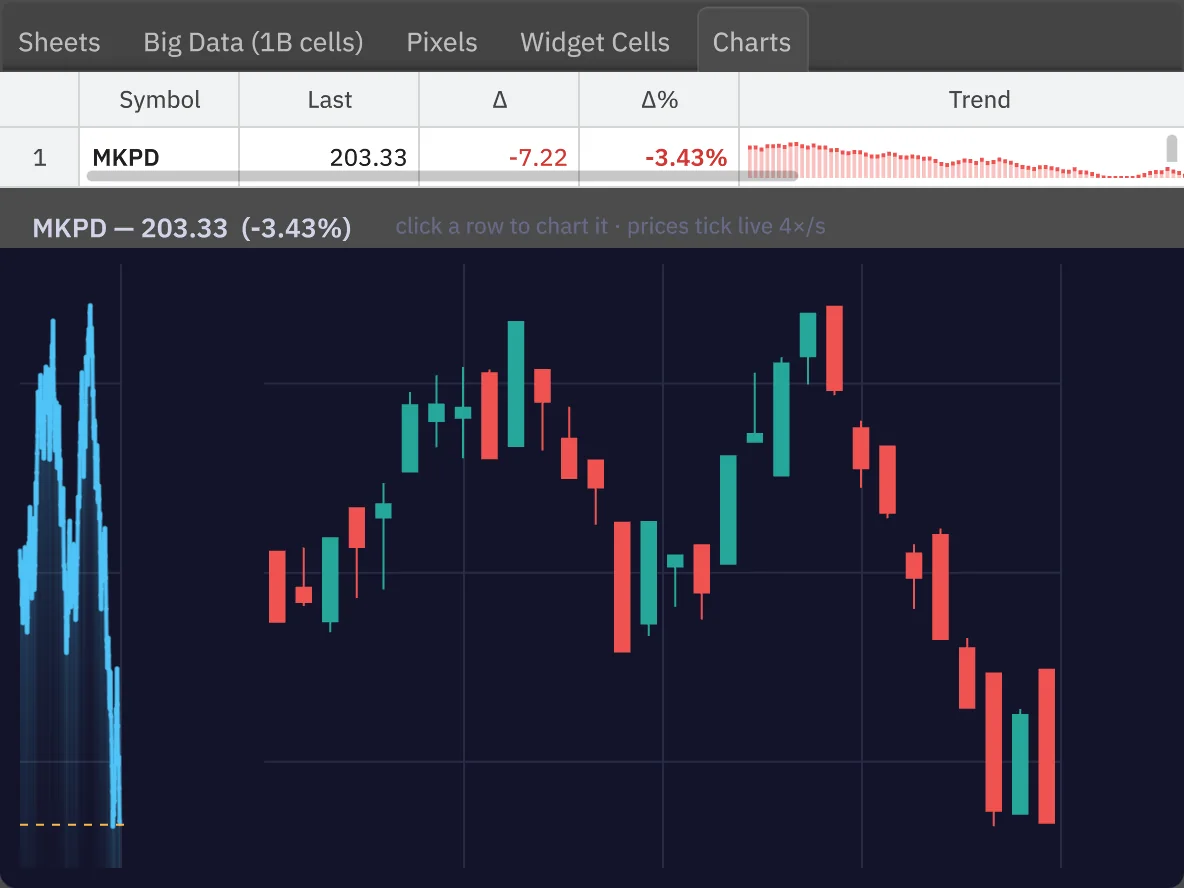
Build me a sales analytics dashboard with charts and KPIs
Generating your dashboard with 4 KPI cards, a revenue trend chart, and a regional breakdown table…

Dynamic Dashboards

Agents compose charts, KPI cards, tables, and filters into a cohesive dashboard — all from a single prompt.

  • Real-time data binding from your APIs
  • Interactive charts with drill-down
  • Responsive layouts across devices
Create an employee onboarding form with validation
Building a multi-step form with personal info, role assignment, and document upload sections…

Smart Forms

Multi-step forms with conditional logic, validation, and file uploads — generated dynamically by agents.

  • Dynamic field generation based on context
  • Built-in validation and error handling
  • Form data flows back to agent for processing
Show warehouse inventory with filters and a map view
Rendering inventory table with category filters and an interactive warehouse location map…

Rich Data Views

Tables, maps, charts, and custom components — agents choose the best visualization for the data.

  • Custom components from your catalog
  • Interactive maps and geospatial views
  • Sortable, filterable data tables

One agent response.
Every screen.

The same declarative UI renders natively on desktop, tablet, and mobile — using each platform's own design system and components.

What will your agent build?

From internal tools to customer-facing products — agents can generate any interface on demand.

📊

Business Intelligence

Ask your agent for reports and get interactive dashboards with live charts, drill-downs, and export capabilities.

🏗️

Internal Tools

Generate admin panels, approval workflows, and operational dashboards without a line of frontend code.

🛒

Customer Interfaces

Dynamic product configurators, booking flows, and support interfaces — personalized per user.

🗺️

Geospatial Apps

Location pickers, route planners, and map-driven analytics rendered with native map components.

📋

Data Collection

Dynamic forms that adapt based on user input — with validation, conditional logic, and submission handling.

🤖

Multi-Agent Orchestration

Agents collaborating to build complex UIs — one handles data, another handles layout, a third manages styling.

Real-world examples

Projects bringing A2App's ideas to life — from Makepad 2.0 native apps to prompt-injection-resistant agent runtimes.

Constraints that actually constrain.

When AI agents generate interfaces, the runtime does the hard work. Rust's guarantees and Makepad 2.0's declarative model give agents expressive freedom — without giving up the rules.

The practical question is not whether to allow AI agents in markets but how to make them work well. Formal verification offers something concrete: constraints that actually constrain, rules that cannot be silently violated, guarantees that hold regardless of what the model learned.

If these trends continue, we may be witnessing another industrial revolution. Before mechanization, most work in the physics sense of force times distance was done by muscles. The steam engine and its descendants changed that. Most thinking used to be done by brains. In the near or far future, that may change too. This is not inevitable. It presumes breakthroughs that are plausible but not guaranteed. But the trajectory is clear enough to take seriously.

— Stephen Diehl, Zero to QED, Ch. 22 "What Comes Next"

This is the bet behind A2App + Makepad 2.0: agents describe what the UI should be; a Rust-native, declarative runtime enforces how it behaves. Expressive freedom for the model, hard guarantees for the user — apps that cannot be silently violated, no matter what the agent learned.

Trust what you render.

A2App uses webviews to embed rich content — and when an agent can influence what appears inside that surface, "probably safe" isn't good enough. Prompt injection, unexpected navigation, and tampered DOM state become real attack surfaces. The engine itself needs guarantees.

🛡️ Formal Verification

formal-web

A browser engine with a formally verified Lean kernel coordinating navigation, session history, and core engine operations — paired with Rust modules for DOM management, rendering, and system I/O. Correctness of the critical path is proven, not just tested.

Why it matters for A2App: when an AI agent can influence the content inside a webview, a verified kernel rules out whole classes of silent violations. This is exactly the "constraints that actually constrain" principle applied at the browser layer — extending Makepad 2.0's Rust-native guarantees into embedded web surfaces.

View on GitHub →

Inspired by A2UI.
Built with Makepad 2.0.

A2App draws inspiration from Google's open A2UI protocol for declarative, agent-driven interfaces — and brings those ideas to life with Makepad 2.0, a Rust-native UI runtime that renders across desktop, mobile, and web.

A2UI Concepts Inspiration

Declarative components, surfaces, data binding, and the adjacency list model for streaming UIs — borrowed as design inspiration, not as a runtime dependency.

Makepad 2.0 UI Runtime

A high-performance Rust UI framework with a reactive DSL, live reloading, and GPU-accelerated rendering — the engine behind every A2App surface.

Component Catalogs Custom

Define which UI components agents can use. Control the visual vocabulary — your design system, your rules.

MCP Integration Interop

Use A2App surfaces over MCP for rich tool responses, embed MCP tools inside surfaces, or combine both.

Ready to turn agents into apps?

Start building with Makepad 2.0, inspired by A2UI concepts. Open source, Rust-native, and production-ready.